



How SoonSer SLA Technology Supports Faster Automotive Lighting Development Cycles
23 May 2026
Industry Insights
Reducing development time in automotive lighting has become a practical goal for many design and engineering teams. At SoonSer, we focus on how SLA 3D printing technology can be applied to shorten iteration cycles in real production environments, especially when teams work on 3D design car parts for concept validation and functional prototyping. Instead of relying only on traditional tooling methods, we use additive manufacturing workflows to support faster design verification, helping teams move from digital models to physical components with fewer delays.
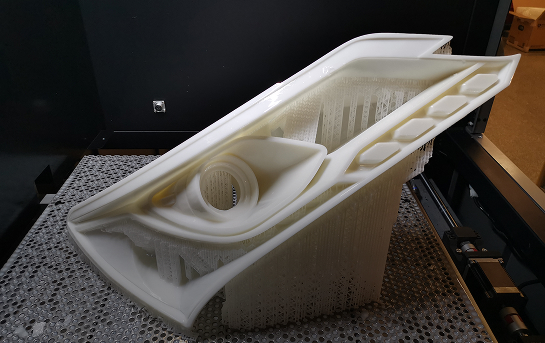
Rapid Iteration for Automotive Lighting Prototypes
In automotive lighting projects, early-stage validation often depends on how quickly physical parts can be tested and adjusted. With SLA 3D printing technology, we support the production of high-detail prototypes that reflect complex surface structures commonly found in lamp housings and optical components. When teams work on 3D design car parts, especially for lighting assemblies, the ability to produce accurate prototypes helps reduce repeated tooling adjustments. Our system enables engineers to evaluate fit, structure, and surface quality directly, which is particularly useful during design review stages where time sensitivity is important. Within this workflow, SoonSer equipment plays a role in maintaining stable output during continuous prototyping cycles without unnecessary interruption to the design process.
Supporting Automotive Design Workflows with SLA Systems
In our daily application scenarios, we see that SLA 3D printing technology is often integrated into automotive R&D environments where iteration speed matters more than complex production scaling. The Mars Pro Series is designed for industrial prototyping tasks such as 3D design car parts, including exterior housings, structural components, and lighting models that require consistent dimensional accuracy. By using resin-based additive manufacturing, design teams can focus on form validation and functional testing rather than waiting for traditional machining cycles. At SoonSer, we apply this workflow to help users streamline early-stage development, especially when multiple design revisions are required within a short time frame.
Application in Industrial Product Development
Beyond automotive lighting, SLA 3D printing technology is also used in other manufacturing sectors where product iteration is frequent. When companies develop 3D design car parts, they often need to test different design variations before final approval. Our systems support this requirement by enabling repeated prototype production with stable process control. The Mars Pro Series, as part of SoonSer, is widely used in industrial environments such as automotive, electronics, and product design studios where prototype consistency is essential for evaluation and communication between engineering and design teams. This makes it easier for users to maintain workflow continuity during fast-paced development cycles.
Conclusion: Shortening Development Cycles with Practical SLA Application
From a practical manufacturing perspective, combining SLA 3D printing technology with 3D design car parts development workflows allows teams to reduce unnecessary waiting time during early prototyping stages. At SoonSer, we focus on supporting this process through stable SLA systems that fit into existing automotive R&D environments. The Mars Pro Series is used in these scenarios to help teams validate design ideas more efficiently and maintain consistent iteration flow, especially in projects where timing plays an important role in product development.

