



How Large Can SLA Printers Get?
20 April 2026
Industry Insights
Size limitations in additive manufacturing are becoming less restrictive as industrial 3D printing technology continues to advance. Industrial SLA 3D printers are available in a wide range of build volumes, from compact production systems to large-format machines capable of producing parts up to 1600 × 800 × 600 mm. This expanded capacity allows manufacturers to handle oversized components, large industrial prototypes, and multiple parts in a single build. For manufacturers and professional 3D printing service providers, choosing the right build volume is not simply about printing bigger parts. It is also about maintaining dimensional accuracy, surface quality, and production efficiency.
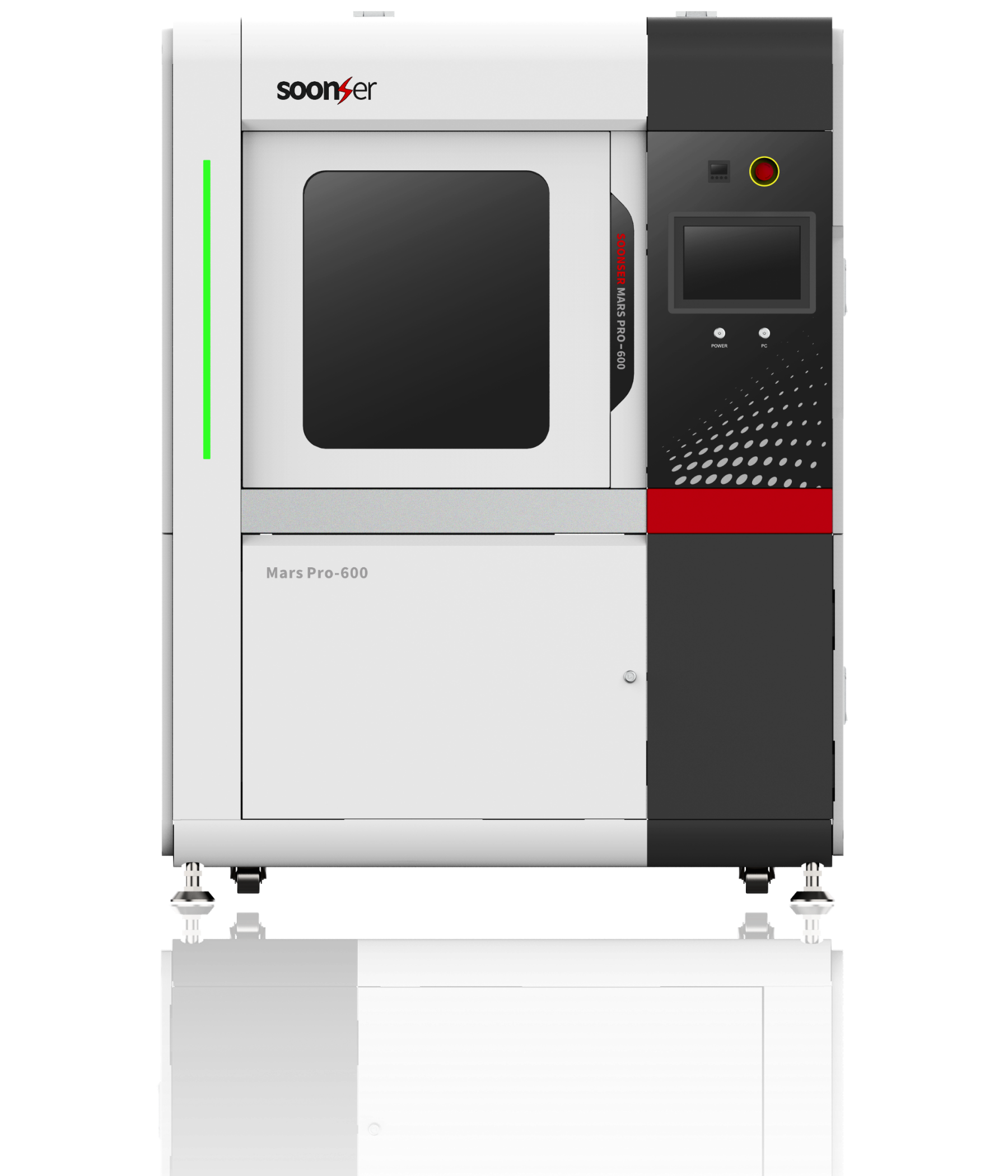
The SoonSer Mars Pro-1600 offers a build volume of 1600 × 800 × 600 mm, the largest in the Mars Pro series. This allows suitably designed oversized components to be printed as a single piece, reducing the need for model splitting, bonding, and additional assembly.
For businesses considering a large-format SLA 3D printer, understanding the relationship between SLA 3D printer build volume, printing accuracy, and application requirements is essential to making the right investment.
Heavy-Duty Stability for Industrial Parts
Maintaining dimensional accuracy becomes increasingly important as SLA 3D printers grow in size. Large industrial components often require consistent geometry, particularly for assembly verification, functional testing, and product development.
SoonSer Mars Pro series machines feature a Grade 00 tri-axis marble platform, providing a heavy and vibration-resistant foundation for stable printing during demanding production operations.
The Mars Pro-1600 offers a published accuracy of ±0.2 mm (L < 100 mm) / ±0.2% × L (L ≥ 100 mm). Smaller models offer tighter tolerances. For example, the Mars Pro-600 provides ±0.1 mm / ±0.1% × L under the same measurement conditions. Buyers should consider both maximum part dimensions and critical tolerance requirements when selecting a machine.
For manufacturers producing industrial components such as tire mold patterns, automotive ducts, and equipment housings, machine stability is an important consideration. A large build volume alone does not guarantee successful printing. Part geometry, material properties, model orientation, and post-curing conditions also influence final accuracy.
SoonSer's tire mold manufacturing case demonstrates how SLA 3D printing can reproduce complex tread patterns for industrial mold applications.
Detailed Artistic Creations Without Seams
Artists, designers, and product development teams often face limitations when working with small build platforms. Large-format SLA technology offers greater flexibility for producing oversized models, sculptures, architectural mock-ups, and complex visual prototypes.
One major advantage of a large SLA 3D printer is the ability to manufacture larger components as a single piece, where design dimensions permit. With a build volume of 1600 × 800 × 600 mm, the Mars Pro-1600 can accommodate suitably designed large models without unnecessary splitting and bonding. This helps reduce visible joining lines and additional assembly work, particularly for applications where surface appearance matters.
SoonSer Mars Pro series machines also feature an intelligent variable light spot system, designed to balance printing efficiency and detail reproduction.
The laser spot adjusts between 0.05 and 0.2 mm, with scanning speeds of 6–15 m/s. A larger spot supports faster exposure over broader areas, while a finer spot helps reproduce intricate surface details. This flexibility is useful for applications such as shoe mold production and tire mold manufacturing, where surface details and geometric accuracy are important to downstream tooling processes.
The final surface quality also depends on resin properties, layer settings, model orientation, and post-processing. Buyers can explore the SLA resin materials range to understand available options for different application requirements.
Operational Efficiency for Service Bureaus
For professional 3D printing service bureaus, production efficiency is just as important as maximum build size. A large-format SLA 3D printer provides more space for arranging multiple parts within a single build, helping service providers handle different customer orders in one production cycle.
Through build nesting, operators can arrange smaller mechanical components, electronic housings, and fixtures alongside larger models, provided that their dimensions and printing requirements fit within the available build volume. This can reduce repeated setup work and improve the utilization of each printing cycle.
SoonSer's electronics product development case provides another example of how SLA 3D printing can support product development and R&D iteration.
When evaluating an industrial SLA 3D printer, buyers should consider more than maximum build volume:
Build Volume: Whether the machine can accommodate the largest parts or multiple orders in one build.
Printing Accuracy: Whether the machine meets the dimensional requirements of the application.
Laser Scanning System: Whether it balances printing speed and fine-detail reproduction.
Machine Stability: Whether the structure supports consistent performance during long print cycles.
Operating Costs: Including resin consumption, labor, maintenance, and post-processing.
These factors help service providers evaluate whether a large-format resin 3D printer can improve production flexibility and meet their long-term business needs.
With the Mars Pro series, SoonSer provides large-format SLA 3D printing solutions for manufacturers, designers, and professional 3D printing service providers. Choosing the right build size and machine configuration can help reduce unnecessary assembly work and improve production efficiency.
Looking for a large-format SLA 3D printer for industrial applications? Explore the Mars Pro series, download the product brochure, or contact our team to discuss your part dimensions and application requirements.

