



SLA vs. LCD: Which Technology Has a Lower Cost per Part for Medium-Scale Production?
2 July 2026
Industry Insights
For medium-scale production, the lower cost per part depends on the balance between print volume, accuracy requirements, and production efficiency rather than the technology alone.
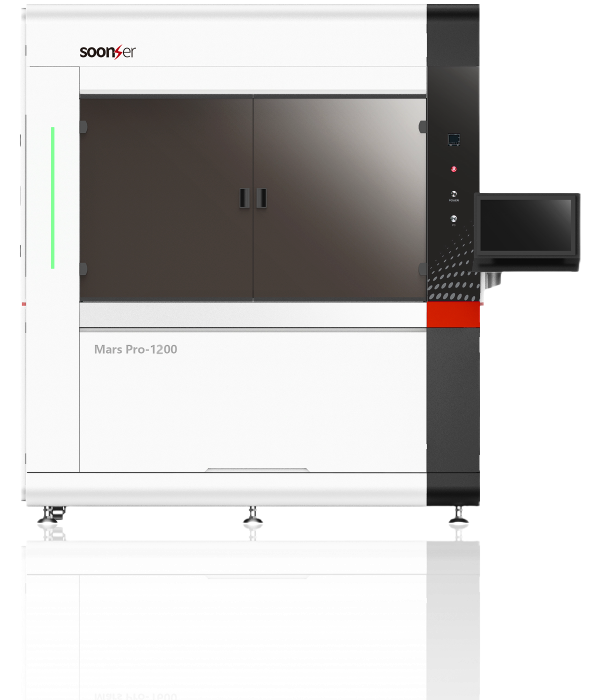
When manufacturers, 3D printing service providers, and creative studios evaluate additive manufacturing technologies, production cost is often a key consideration. Comparing sla 3d printing cost with LCD printing requires looking beyond the initial equipment investment and focusing on throughput, material usage, precision, and application requirements. At Soonser, we work with both SLA and LCD technologies and understand that different production environments demand different solutions. For medium-scale production, the answer is not always straightforward, especially when part quality and consistency are important.
SLA Technology and Production Efficiency
When analyzing sla 3d printing cost, one important factor is production efficiency. SLA systems such as the Mars Pro Series use advanced laser scanning technology and are designed for rapid prototyping as well as scalable production. Multiple build size options allow manufacturers to produce larger components or multiple parts within a single production cycle. This flexibility can help reduce the cost per part when production volumes increase.
At Soonser, our industrial SLA printers are used across manufacturing, automotive, healthcare, and artistic applications because they provide high precision, reliable surface quality, and compatibility with a wide range of resin materials. For medium-scale production runs that require consistent dimensional accuracy and detailed surface finishes, SLA technology can provide strong value over the long term.
LCD Technology and Equipment Investment
LCD printing is often considered when businesses are looking for a low cost industrial 3d printer solution. The Mercury-D6K-H LCD printer is designed with a compact footprint and high-resolution printing capability. Its focus on precision industries and laboratories demonstrates how LCD technology can deliver detailed results while maintaining a relatively compact system design.
For organizations entering resin-based production, a low cost industrial 3d printer can be attractive because it may reduce the initial equipment investment compared with larger industrial systems. LCD technology is particularly suitable when production involves smaller components and applications where a compact workflow is preferred. However, the overall production economics should still be evaluated according to actual production targets, part dimensions, and quality expectations.
Comparing Cost per Part in Medium-Scale Production
The comparison between sla 3d printing cost and LCD printing becomes more meaningful when examining medium-scale manufacturing requirements. Larger industrial SLA systems offer scalable build volumes, including models designed for larger-format production. These capabilities can support higher output levels and enable multiple parts to be produced efficiently within a single build.
At the same time, companies searching for a low cost industrial 3d printer should consider more than the purchase price. Factors such as printer stability, production reliability, material compatibility, and workflow efficiency all contribute to the final cost per part. For medium-scale production involving larger batches, larger components, or demanding surface quality requirements, industrial SLA systems may provide cost advantages through production efficiency and scalability. For smaller precision-focused applications, LCD technology may offer a practical alternative.
Conclusion
Based on our experience at Soonser, the lower cost per part for medium-scale production depends on the production scenario. SLA technology offers scalable production capabilities, large build-volume options, and high-precision performance that can support efficient manufacturing workflows. LCD technology provides a compact and accessible solution for precision-oriented applications. By evaluating production volume, part size, and quality requirements together, manufacturers can identify the technology that delivers the most suitable balance between investment and long-term production efficiency.

