



SoonSer SLA Industrial Stability Behind Optical System Logic
30 May 2026
Industry Insights
For manufacturers working with high-detail prototypes and functional models, consistency matters more than short-term performance claims. At SoonSer, we understand that the real expectation from an SLA 3D printer manufacturer is not only precision output, but also stable operation across long production cycles. This is especially important for industries such as automotive, footwear, and electronics, where repeated printing tasks are part of daily workflows. Our approach to industrial SLA 3D printer development focuses on controlling the optical system behavior so that each layer exposure remains consistent throughout the printing process. This stability is what allows users to maintain predictable results in both prototyping and small-batch manufacturing environments.
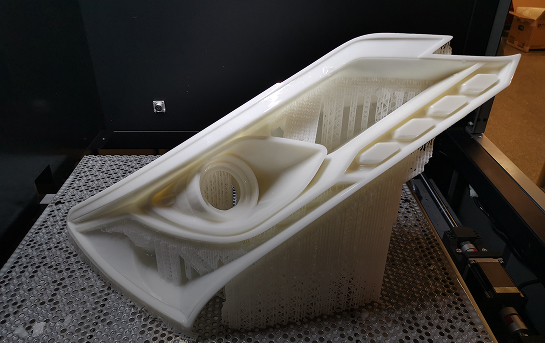
Optical Logic in Industrial SLA Systems
The stability of an SLA system is closely linked to how the optical engine manages light distribution and energy consistency. In our industrial SLA 3D printer, the optical structure is designed to maintain uniform exposure across the build area, reducing fluctuations that could affect part accuracy. At SoonSer, we focus on how the light path, resin reaction, and layer curing interact during continuous operation rather than isolated print tests. As an SLA 3D printer manufacturer, we pay attention to how optical consistency supports real production scenarios, especially when users run long print jobs for functional prototypes or mold development. This method helps ensure that surface quality and dimensional behavior remain stable even when production demands increase.
Application Behavior in Manufacturing Environments
Different industries evaluate SLA systems based on how well they perform in actual production conditions rather than laboratory settings. Our industrial SLA 3D printer is often used in environments where engineers and designers iterate multiple versions of a product within short development cycles. The Mars Pro Series from SoonSer is designed to support this workflow with a focus on structural reliability and repeatable output behavior. As an SLA 3D printer manufacturer, we continue refining system architecture so that optical performance remains steady during continuous operation, which is especially relevant for service providers handling multiple client projects and industrial users working on tire molds or detailed functional components.
Conclusion: Stability Driven by Optical Design
The core reason behind SLA system stability is not a single component but the coordination of optical design, exposure control, and system structure. At SoonSer, our role as an SLA 3D printer manufacturer is to ensure that these elements work together in a consistent way inside every industrial SLA 3D printer we develop. The Mars Pro Series reflects this approach by focusing on predictable printing behavior for manufacturing, design, and service applications. In practice, industrial SLA 3D printer performance is ultimately defined by how stable its optical logic remains under real production conditions, and this is the area we continue to refine within SoonSer systems.

