



Inside LCD 3D Printing Understanding Its Technology and Benefits
13 October 2025
Industry Insights
Understanding how an LCD 3D printer works allows us to appreciate why this technology has become a reliable choice for rapid prototyping and small-scale production. At SoonSer, we have spent years refining resin-based printing systems to provide precision, stability, and user-friendly performance for different industries. Compared with other additive manufacturing methods, LCD 3D printer technology offers a balance of cost, accuracy, and efficiency, making it suitable for applications such as dental modeling, product prototyping, and design testing.
The Core Mechanism Behind LCD Printing
The process of LCD printing involves projecting light through a high-resolution LCD panel to selectively cure layers of photosensitive resin. Each layer is displayed on the screen, allowing the resin to solidify only in the illuminated areas. This layer-by-layer approach ensures a high level of detail and smooth surface quality. At SoonSer, our Smart series and Mercury series adopt this principle but enhance it with more stable light uniformity and advanced cooling systems to ensure consistent results during long printing sessions.
Unlike laser-based systems that require mechanical scanning, LCD printing achieves faster layer exposure and simpler maintenance. This makes it ideal for laboratories and small production environments that need both precision and efficiency. Our machines, such as the Mercury-D6K model, feature 4K resolution and optimized resin management systems to reduce material waste while ensuring accuracy in every print.
Benefits of Large LCD 3D Printers
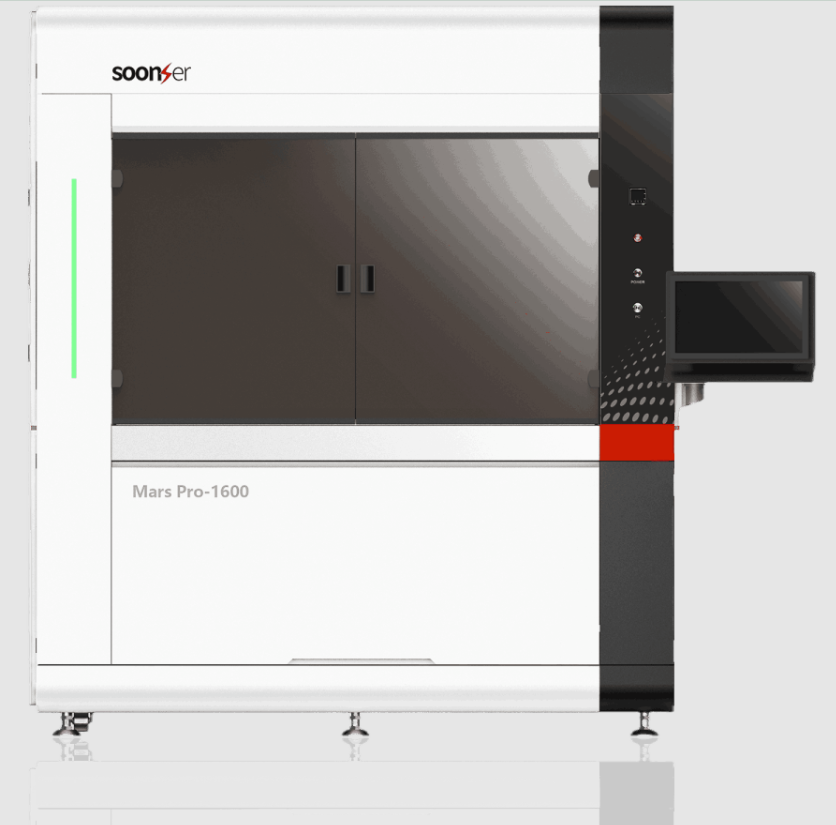
The development of large LCD 3D printer technology has expanded the potential of resin printing far beyond small prototypes. By increasing the build volume while maintaining optical uniformity, we have made it possible for users to print large models or multiple parts simultaneously. At SoonSer, our Smart-H series integrates modular design and enhanced cooling performance, allowing consistent curing quality across wide surfaces. This enables applications in industries like footwear modeling, automotive prototyping, and artistic sculpture fabrication.
The advantage of a large LCD 3D printer also lies in its scalability. Users can manage bigger production tasks without compromising fine details or dimensional stability. For industrial users, this reduces the need for multiple smaller machines, saving both time and cost. Our clients in manufacturing and research sectors appreciate how our systems can adapt to varying production requirements with minimal calibration.
Practical Applications and Future Outlook
In our daily work at SoonSer, we continue to explore new ways to make LCD 3D printer technology more accessible and efficient. From dental labs that need delicate precision to engineering firms seeking durable prototypes, our range of products supports diverse goals. We also develop compatible resin materials and open parameter settings so users can experiment and achieve their desired performance.
Looking ahead, LCD printing will play a growing role in customized production and educational training. As we keep refining our equipment and software, we are committed to helping users achieve more accurate, faster, and cleaner results. Whether it is through compact desktop models or advanced large LCD 3D printer systems, SoonSer remains dedicated to driving progress in additive manufacturing with innovation, reliability, and attention to real-world needs.

