



How Does SLA 3D Printing Work in Industrial Manufacturing Environments
14 May 2026
Industry Insights
Understanding how does SLA 3D printing work is essential for manufacturers, service providers, and design teams who rely on stable prototyping and production workflows. At SoonSer, we focus on explaining the process through real industrial use rather than abstract theory. The SLA 3D printer mechanism is based on layer-by-layer photopolymerization, where liquid resin is selectively cured by a laser system to form precise geometries. This process supports consistent 3D printing work across automotive, footwear, electronics, and artistic applications, where surface quality and dimensional accuracy are important for downstream production decisions.
Core Structure Behind SLA Printing Process
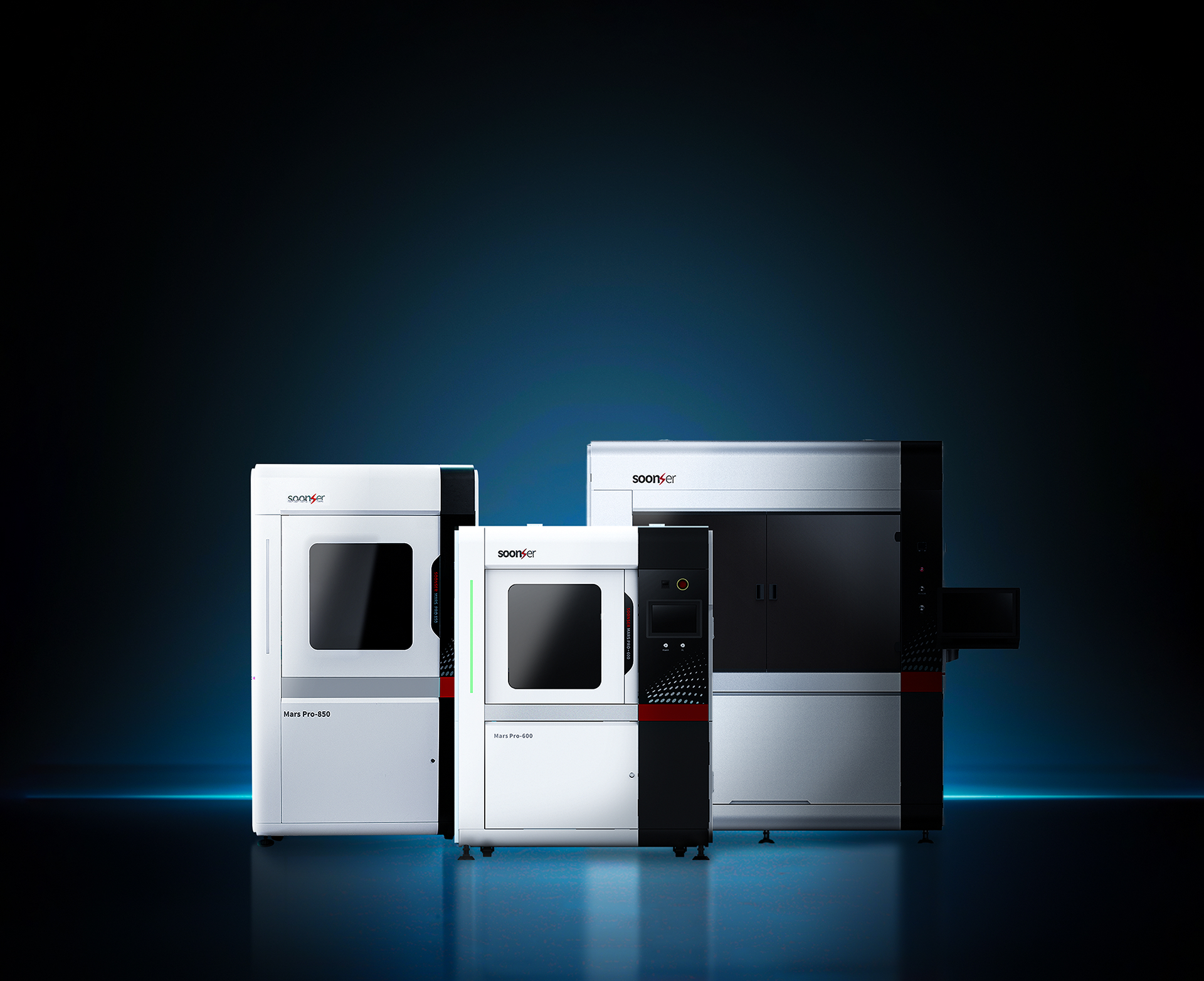
To understand the SLA 3D printer mechanism, it is important to look at how the system is constructed. In our industrial equipment design, a laser source, galvanometer system, resin tank, and build platform work together to complete each layer of a model. The laser traces each cross-section according to digital design data, gradually building a solid object from liquid resin. In real 3D printing work environments, this method allows users to produce detailed prototypes without requiring complex tooling. At SoonSer, we develop systems like the Mars Pro Series SLA platform to support stable operation during long production cycles, especially for users in manufacturing and service industries who require repeatable output rather than one-off samples.
Application Scenarios in Industrial Production
In manufacturing environments, how does SLA 3D printing work is closely connected to practical production needs rather than laboratory explanations. Many users apply this technology for prototype validation, functional part testing, and design verification before moving into mass production. The SLA 3D printer mechanism enables smooth surface finishes, which reduces post-processing time in many 3D printing work workflows. In industries such as automotive component design, footwear mold development, and electronic housing prototyping, SLA technology helps teams iterate faster while maintaining consistent part quality. SoonSer systems are designed to support these industrial scenarios by focusing on operational stability, which is especially important for service providers handling multiple client projects in parallel.
Integration with Modern Manufacturing Workflows
Modern production environments require flexible and repeatable 3D printing work processes that can adapt to changing design requirements. By understanding how does SLA 3D printing work, companies can better integrate additive manufacturing into their existing workflows. The SLA 3D printer mechanism allows digital models to be directly converted into physical parts, reducing dependency on traditional tooling in early development stages. In SoonSer applications, this approach is widely used in rapid prototyping, design verification, and small-batch model production. The Mars Pro Series provides a stable platform for users who need consistent output quality while managing continuous production demands across different industries.
Conclusion
Overall, how does SLA 3D printing work can be understood as a controlled photopolymerization process supported by precise mechanical and optical systems. The SLA 3D printer mechanism ensures that each layer is accurately formed, making it suitable for detailed and repeatable 3D printing work in industrial settings. At SoonSer, we design our systems to support manufacturers, service providers, and creative professionals who require reliable performance in daily production tasks. This combination of process stability and application flexibility allows SLA technology to remain a practical solution in modern manufacturing workflows.

